Guide to the Printable Cursive Handwriting Practice Sheets
What Is in the Set
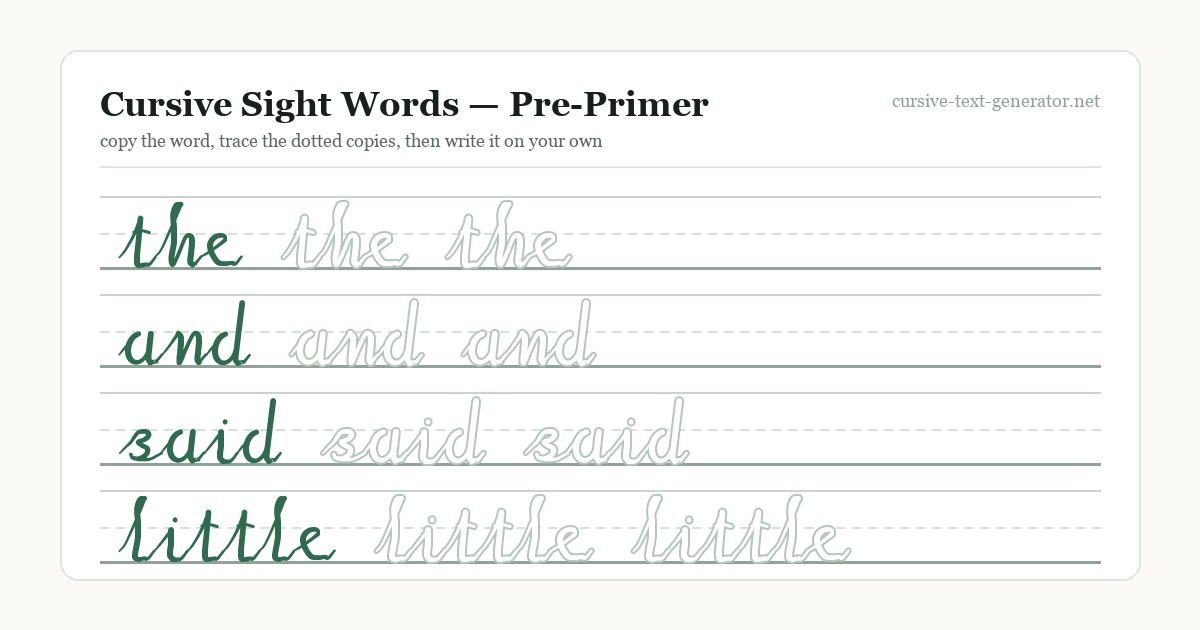
These printable cursive handwriting practice sheets cover the whole sequence a handwriting scheme follows, in the order it follows it. The blank paper is plain three-line ruling in three sizes and is used alongside every other sheet. The alphabet sheets drill single letters. The word sheets take those letters into the Dolch sight-word lists, the days and the months, so joins are practised where they actually occur. The sentence sheets add word spacing, capitals and punctuation. Names are the one thing a fixed sheet cannot cover, so that section links to the two name generators instead.
All 13 sheets are set in the same cursive letterform — CTG Everly Script, a plain, monoline-style joined hand with a clear x-height — on the same three-line ruling, so a student sees one consistent model from the first letter sheet to the last sentence sheet.
How Each Row Works
Every practice row on the letter and word sheets has the same three parts. On the left is a solid model in green — the correct form to look at. Next come dotted outline copies to trace, three for a letter and two for a word, which put the pen on the right path without the student having to recall the shape. The rest of the row is blank ruled space to write the letter or word unaided. Look, trace, write — on every row, so the student never traces a whole page before attempting the form on their own.
The sentence sheets drop the tracing step. The sentence is written out in full as a model, and the same number of blank ruled lines sits directly beneath it. By the time a student is copying sentences, recall of the letter shapes is the point; what they are practising is spacing, size consistency and keeping a steady hand across a whole line.
Which Ruling Size to Print
- Wide, 19 mm (ages 6–8). First cursive letters and joins. The alphabet sheets use this size. The large x-height suits the whole-arm movement beginners write with, and mistakes in loop size or oval closure are easy to see.
- Standard, 15 mm (ages 8–10). Words and short sentences once letter shapes are secure. The word sheets use this size, and it is the ruling of most Grade 3–4 handwriting workbooks.
- Narrow, 11 mm (ages 10+ and adults). Fluent writers, copywork and anyone relearning cursive. The sentence sheets use this size; it is close to the 8 mm feint ruling of a standard exercise book, with a midline added.
If in doubt, print a page of each blank ruling and have the student write their name on all three. The right size is the one where the lowercase letters fill the space between baseline and midline without cramping.
Suggested Order: Letters, Words, Sentences
The sheets are numbered in teaching order, and the order matters more than the pace. Start with the lowercase alphabet sheet, one page a session. Move to the pre-primer sight words as soon as most lowercase letters are recognisable, even before they are neat — joining letters into real words is what makes cursive feel worthwhile to a child, and the sight words are short. Add the uppercase alphabet when names and sentence starts need capitals, then the days, months and primer words for longer words with capital joins. Finish with the simple sentences and, for older students, the pangrams, which cover every letter and join in five lines.
This is the sequence set out in the English national curriculum programmes of study — letter formation in Year 1, joins in Year 2, consistently joined writing across all subjects from Year 3 — and it maps closely onto the Grade 2–4 window in which most US states that teach cursive introduce it.
Printing Tips for Practice Sheets
- Sheets are sized for A4 portrait and fit US Letter at the printer’s default scaling. Set margins to none or minimum if the print dialog offers it.
- Print in black and white if you prefer: the green model letters print as a solid dark grey and the dotted copies stay visibly lighter.
- Laminate the blank paper and the alphabet sheets and reuse them with a dry-erase pen — the three-line ruling does not wear out.
- For a class set, save as PDF once and print the PDF, rather than printing from the browser 30 times.
- The PNG download is rendered at 2× (1588 × 2246 px), sharp enough to print or to drop into a Google Slides handwriting activity.
Ready-Made Sheets vs the Generators
Everything on this page is fixed: print it and go. When you need something specific — a spelling list, this week’s topic vocabulary, a child’s name, or the alphabet cut down to one letter family — the generators make the same style of sheet from your own text: the cursive practice sheets generator for words and phrases, the cursive alphabet practice sheet for letter families and custom letter sets, and the name tracing and name practice generators for names. For the shape of any single letter, its joins and the letters it is confused with, see cursive letters A–Z.
Printable Cursive Handwriting Practice Sheets FAQ
Are the sheets free?
Yes — all 13 sheets are free for classroom and home use, with no account, watermark or download limit. Print from the page, save as PDF, or download PNG images.
What paper size are they?
A4 portrait, and they fit US Letter with default scaling. Only the worksheet prints; no navigation, buttons or page text.
Which ruling should a beginner use?
Wide (19 mm) for the first letters and joins, standard (15 mm) once words are joined consistently, narrow (11 mm) for fluent writers and copywork. All three are in the blank paper set.
What order should the sheets be used in?
Letters, then words, then sentences: lowercase alphabet → pre-primer sight words → uppercase alphabet → days, months and primer words → simple sentences → pangrams.
Can I make a sheet with my own words or a name?
Yes — the sheets here are fixed sets. Use the practice sheets generator for your own words and the name tracing generator for a name.
How do I save a sheet as a PDF?
Click Print / PDF on the sheet and choose “Save as PDF” as the printer. Multi-page sets save as one PDF with one worksheet page per PDF page.