Varsity Fonts: What Copies and What Does Not
Varsity lettering splits cleanly into a part text handles well and a part it does not, and the split runs between numbers and letters.
Numbers copy well. Unicode has seven complete digit sets — heavy serif, heavy sans, double-struck, monospace, full width, filled circle and outlined circle — and all of them are widely supported. A two-digit jersey number in heavy sans or double-struck genuinely reads as a jersey number when you paste it into a bio, a message or a team chat. The chart above has every digit individually.
Team names are harder. The copyable letter styles — filled and outlined jersey letters, heavy sans, double-struck, wide caps — are blocky and capitalised, and they hold up in a display name or a chat. But they are enclosed and mathematical characters rather than an athletic typeface, and they carry no outline, no shadow and no arch, because none of those exist as text.
That is what the Preview only cards are for. They use heavy display faces from your device plus the arch, outline, shadow and spacing controls, so you can see a team name laid out the way it would sit on a jersey. Copying one gives you the plain letters — the button says “Copy text” — and the styling stays on this page. For a real design, set it in a design tool with a licensed athletic typeface.
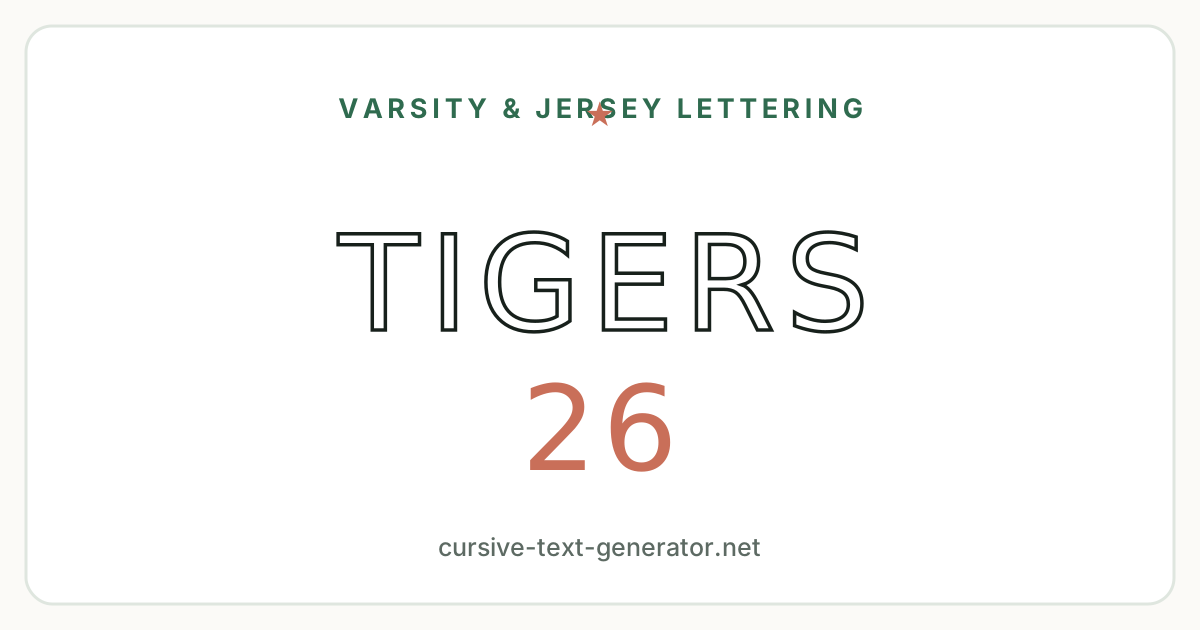
How to Use the Varsity Font Generator
- Type a team name, player name, or a number into the box at the top. Everything redraws as you type.
- Turn on Arch to curve a team name the way it sits across a jersey, then add Outline and Shadow.
- Adjust Letter spacing until a long name fills the line without crowding. Uppercase changes the real characters, so it carries through a copy; the other three do not.
- Filter by Copyable to see only the styles that survive a paste, or by Jersey for the condensed, number-friendly ones.
- For a jersey number on its own, use the 0–9 chart above — every digit copies individually.
Everything runs in your browser. Nothing you type is uploaded or stored.
Varsity Fonts for Jerseys, Teams and Sports Text
Varsity lettering is one of the few display styles with a fixed layout attached to it. Understanding the layout makes the style choices obvious.
The team name arches. On the front of a jersey or the chest of a jacket, the team name curves upward across the shoulders. The arch exists because the surface curves and because it makes a long name fit a wide, shallow space. Longer names need a deeper arch — the Arch control scales the curve with the length of your text, so type a real name and watch what happens.
The player name runs straight. Across the shoulders on the back, above the number, a surname is set flat and usually condensed. This is why Condensed Sports exists as its own style: a nine-letter surname has to fit the same width as a four-letter one.
The number is the largest element. It is read from furthest away, so it carries the heaviest weight, the clearest outline and the strongest shadow. It is also the part that copies best — see the number chart above.
Outline and shadow do the separating. A jersey is a coloured surface, so block letters need a keyline to stand off it and a shadow to lift them. Turning both on in the controls is the closest this page gets to a real jersey preview.
For academic block lettering rather than sports — school names, department names, class years — the college block font generator is the page for that, and it uses a straighter, less number-driven treatment. One legal note worth stating: real team names, logos and marks are trademarked. Preview your own text here, and do not reproduce an existing team's branding on anything you sell.
Where to Use Varsity Lettering
Short, capitalised, number-friendly text is what this style is for:
- Jersey and kit mockups — check how a surname and number look together before ordering anything.
- Team social accounts — a team name in heavy sans or double-struck for a bio or display name.
- Fantasy league and group chats — jersey numbers and short team names that paste straight into a message.
- Sports posters and match graphics — rough out a headline before setting real type.
- Club merch drafts — compare a club name across block, condensed and slab in one view.
- Streaming overlays and scoreboards — monospace numbers keep their width, so a score does not shift as it changes.
What Varsity Text Cannot Do
The honest boundaries of a text-based varsity generator:
- No arch in copied text. Arching positions each character individually. Copied text sits on one straight line, always — the arch is a preview effect only.
- No outline or shadow in copied text. Both are CSS. They are not properties any character carries.
- No true athletic letterform. Unicode's block characters are letters inside boxes, not heavy varsity strokes. The number sets are much closer to the real thing than the letters are.
- Filled block letters may render in colour. Several platforms treat that range as emoji, so a monochrome team name can arrive as coloured tiles.
- No two-colour lettering. Real varsity type layers a fill and an outline in different colours. Text is a single colour, set by whatever app it lands in.
The numbers are the exception worth repeating: those work, they are widely supported, and they are genuinely useful on their own.
Varsity Font Generator FAQ
What is a varsity font?
It is the athletic lettering style used on jerseys, letterman jackets and team merchandise — heavy squared capitals with a contrasting outline and an offset shadow, usually arched for a team name and paired with a large jersey number.
Can I copy and paste varsity fonts?
Numbers, yes — all seven digit styles here are Unicode and widely supported. Letters, partly: the copyable letter styles are blocky and capitalised but carry no outline, shadow or arch. The cards marked Preview only are CSS renderings and copy as plain text.
How do I make arched varsity text?
Turn on the Arch control and the preview cards curve each letter along an arc, with the curve scaling to the length of your text. It is a preview effect only — arched text cannot be copied, because arching requires positioning every character individually.
Can I make a jersey number?
Yes, and this is what the tool does best. The 0–9 chart gives you seven number styles, each digit copyable on its own. Combine two digits for a jersey number. Heavy sans and double-struck read most convincingly; monospace keeps a fixed width, which is useful for scoreboards.
What is the difference between varsity and college block lettering?
Varsity is the sports register — jersey numbers, player and team names, arched layouts, outline and shadow. College block is the academic register — school and department names, class years and campus signage, usually flatter and straighter. Our college block font generator covers that side.
Why do my block letters show as coloured squares?
Several platforms treat the filled block character range as emoji rather than text and render it as coloured tiles. For a reliably monochrome result use heavy sans, heavy serif or double-struck, which are supported as plain text nearly everywhere.
Can I use a real team's name and logo?
Team names, logos and marks are trademarked. Previewing text for your own use is fine, but do not reproduce an existing team's branding on merchandise or anything you sell. This tool contains no team logos or licensed marks.
Is the varsity font generator free?
Yes. No account, no sign-up, no watermark, and no limit on how much text you convert or copy.