Cursive E Stroke Order
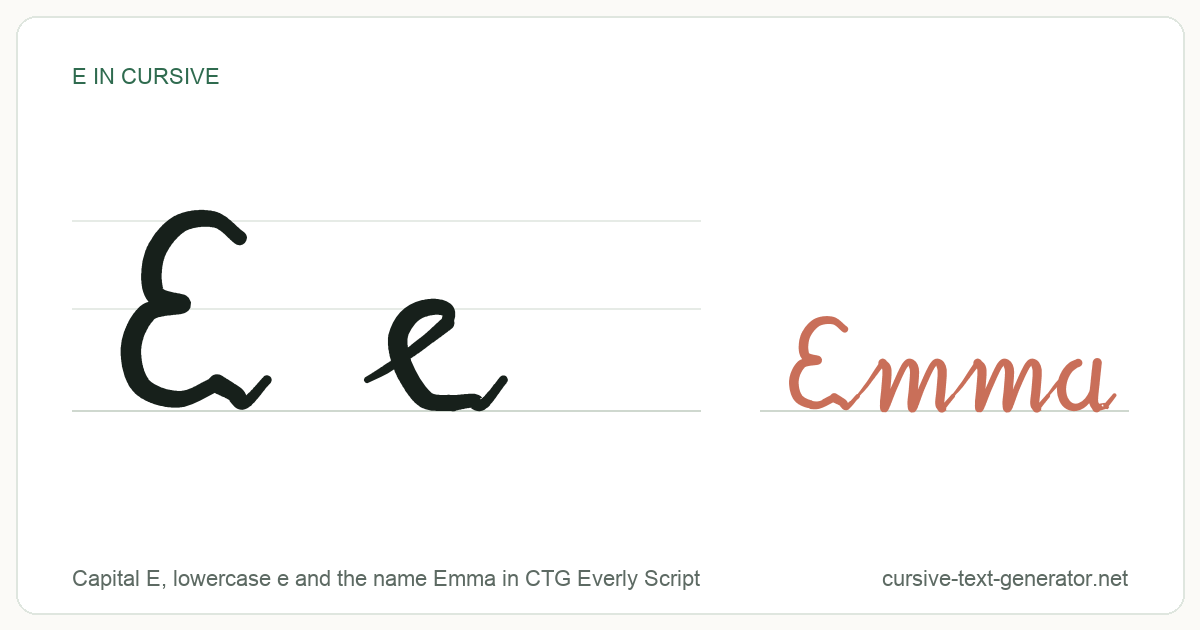
How to Write a Capital E in Cursive
- Start below cap height with a small hook curling left.
- Sweep left and round into the upper loop, closing it near the middle.
- Carry the stroke on into a larger lower loop.
- Round the baseline and exit to the right.
Two loops, upper smaller than lower. A single-loop capital E is a capital C.
How to Write a Lowercase e in Cursive
- Start on the baseline and rise diagonally into the loop.
- Carry the stroke up and over to the left at x-height.
- Come down and round the baseline, closing the loop against your upstroke.
- Exit right along the baseline.
Keep the loop open. A filled-in e is the most common cause of unreadable cursive, because e is the most frequent letter in English.
Cursive e vs Cursive i
A closed-up e and an undotted i are the same short mark inside the x-height. The e has a loop and the i does not, but the loop is the first thing to fill in when you speed up, and the i's dot is the first thing to be forgotten. Since e is the commonest letter in English, an e that closes turns a whole line of writing into guesswork.
Joining Cursive e: Keep the Loop Open
The e enters low and exits low, which makes it the most connectable letter in the alphabet — one reason it appears in so many common pairs. The exception is entering an e after a high-exiting letter such as o, v, b or w, where you have to drop into the loop from above and it tends to close up.
Cursive E Mistakes: A Closed Loop and a Loop Too Tall
- A closed loop. The single biggest legibility problem in cursive.
- A loop reaching the ascender. That makes it an l.
- Starting at the top. The e is written upward from the baseline into the loop.
- A pointed loop. The e loop is round; pointing it produces an i or a v.
Names Starting With E in Cursive
- Emma — ℰ𝓂𝓂𝒶
- Ethan — ℰ𝓉𝒽𝒶𝓃
- Eleanor — ℰ𝓁ℯ𝒶𝓃ℴ𝓇
- Eli — ℰ𝓁𝒾
Countries and Languages Starting With E in Cursive
- England — ℰ𝓃ℊ𝓁𝒶𝓃𝒹 · England in cursive: Capital E, g Descender, vs Britain
Words Beginning With e in Cursive
- ember — ℯ𝓂𝒷ℯ𝓇
- echo — ℯ𝒸𝒽ℴ
- elm — ℯ𝓁𝓂
Want a whole word or sentence? Use the cursive letters generator, or the cursive name generator for names. To practise these strokes on paper, print a cursive practice sheet.
Cursive E FAQ
What is the cursive E?
The cursive E is the joined-up form of the letter E. The capital is a double curve of two stacked loops; the lowercase is a single small loop inside the x-height that enters and exits on the baseline. Online, “cursive E” also means the copy-and-paste characters (ℰ and ℯ) above.
How do you write e in cursive?
In short: rise diagonally from the baseline, loop over to the left at x-height, come down and close the loop against your own upstroke, then exit along the baseline. Steps and the diagram are above.
Why does my cursive e look like an i?
The loop has closed. An e with a filled-in loop is a short mark, which is exactly what an undotted i looks like. Keep the loop visibly open — this matters more for e than any other letter because it is the most frequent letter in English.
What is the difference between a cursive e and a cursive l?
Height. Both are loops rising from the baseline; the e stays inside the x-height, the l reaches the ascender line. Nothing else separates them.
Can I copy and paste a cursive e?
Yes. The lowercase Cursive Script e (ℯ) is one of three lowercase letters — with g and o — that Unicode encoded in the Letterlike Symbols block rather than the Mathematical Script block, so it can look slightly different in weight. It pastes normally.